

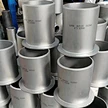
STUB END
Characteristics of Stub Ends
Two Components: A stub end consists of two parts: the main body and the loose backing flange.
Loose Flange: The loose backing flange is attached to the pipe and acts as a rotating backing ring, while the main body of the stub end remains stationary.
Facilitates Alignment: Stub ends facilitate easy alignment of pipes with different diameters, allowing for a smooth transition in the piping system.
Joint Seal: The joint between the stub end and the backing flange is typically sealed with a gasket to prevent leaks.
Applications of Stub Ends
Piping Transitions: Used in piping systems where there is a need to connect pipes of different sizes or materials.
Pipe Support: Stub ends can serve as support points for pipes, ensuring stability and preventing sagging or misalignment.
Maintenance Access: Facilitate easy disassembly and access to the piping system for maintenance or repairs.
Advantages of Stub Ends
Versatility: Suitable for a wide range of piping applications requiring transitions between different pipe sizes or materials.
Easy Installation: Stub ends are relatively easy to install and can be quickly assembled or disassembled as needed.
Cost-Effective: Provide a cost-effective solution for connecting pipes of varying diameters without the need for complex fabrication.
Stub ends are commonly used in piping systems across various industries, offering a convenient and efficient way to accommodate transitions between pipes of different sizes while ensuring a secure and leak-free connection.


Comprehensive score