

Pipe Bend With Tangent
Apipe bend is a type of pipe fitting used to change the direction of the flow in a piping system. Unlike elbows, which have specific angles (like 90 degrees or 45 degrees), pipe bends can be made with a variety of radii and angles, making them versatile for many applications.
Key Features of this kind of pipe fittings:
Design:
- Pipe bends are typically characterized by their radius, which can be short, long, or even custom.
- They allow for gradual changes in direction, which helps reduce turbulence and pressure loss in fluid systems.
Types of Bends:
- Long Radius Pipe Bend: This kind of pipe fitting has a radius that is at least equal to 1.5 times the nominal diameter of the pipe. This type is commonly used to minimize turbulence and pressure drop.
- Short Radius Pipe Bend: This kind of pipe fitting has a radius that is equal to the nominal diameter of the pipe. Used where space is limited but may cause more turbulence than long radius bends.
- Custom Pipe Bends: This pipe fitting can be made to specific angles and radii to suit the design requirements of a particular system.
Material of this kind of pipe fittings:
- Pipe bends can be manufactured from various materials, including:
- Carbon Steel: Commonly used in oil and gas applications.
- Stainless Steel: Ideal for corrosive environments.
- Alloy Steel: Used for specialized applications requiring enhanced properties.
- Plastic: Such as PVC or CPVC, for low-pressure applications and chemical processing.
- Pipe bends can be manufactured from various materials, including:
Standards Compliance:
- Pipe bends may comply with various international standards, such as ANSI/ASME, ASTM, or GOST, depending on application and geographical location.
Applications of this kind of pipe fitting:
- Oil and Gas Industry: Frequently used in pipelines to transport crude oil, natural gas, and refined products.
- Chemical Processing: Suitable for handling corrosive substances safely.
- HVAC Systems: Used in heating, ventilation, and air conditioning systems to redirect airflow.
- Water Treatment Facilities: Employed in water supply and wastewater treatment systems.
Benefits
- Reduced Pressure Drop: The gradual change in direction minimizes fluid velocity changes, leading to less energy loss.
- Space Efficiency: Available in various sizes and radii, allowing for flexibility in tight spaces.
- Durability: When made from high-quality materials, pipe bends offer excellent resistance to wear, corrosion, and high pressure.
- Versatility: Can be used in a wide range of applications across different industries.
Conclusion
Pipe bends are essential components in many piping systems, providing effective solutions for changing direction while minimizing pressure loss and turbulence. Their availability in various materials, sizes, and radii allows for customization to meet specific project requirements. Proper selection and installation of pipe bends ensure optimal performance, efficiency, and reliability in fluid transportation systems across diverse industries.
Drawing of 24 DEGREE 10"SCH40 5D Bend With 300mm Tangent:
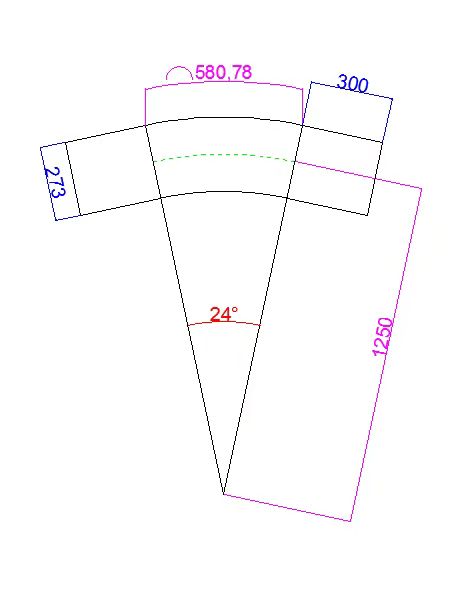
A pipe bend can be in any degree and any radius.The most regular pipe bends are 30 degree,45 degree,90 degree,the popular bending radius are 3D,5D, 7D,10D,here the “D” means the nominal diameter of this bend.
Standard: ASME/ANSI B16.49, MSS-SP-75,
Material: ASTM A860,API 5L GR.B/GR.42/GR.52/GR.60/GR.65/GR.70 ,ASTM A370, EN 10208-2
Size: 2″-48″. DN50-DN1200
Connect method: Butt welding.
Type:
Seamless: DN50-DN1200,
Welded: DN50-DN1200


Comprehensive score